
Concrete coatings for the Mahoning Valley
Epoxy Flooring in Youngstown, OH
Garage, basement and shop floors built for 68 inches of snow a year, old slabs and damp springs.
- Free on-site estimate with a slab moisture test
- Itemized written quote before any grinding starts
- Old paint, sealer and failed kits removed down to sound concrete
Coatings Made for Old Valley Concrete
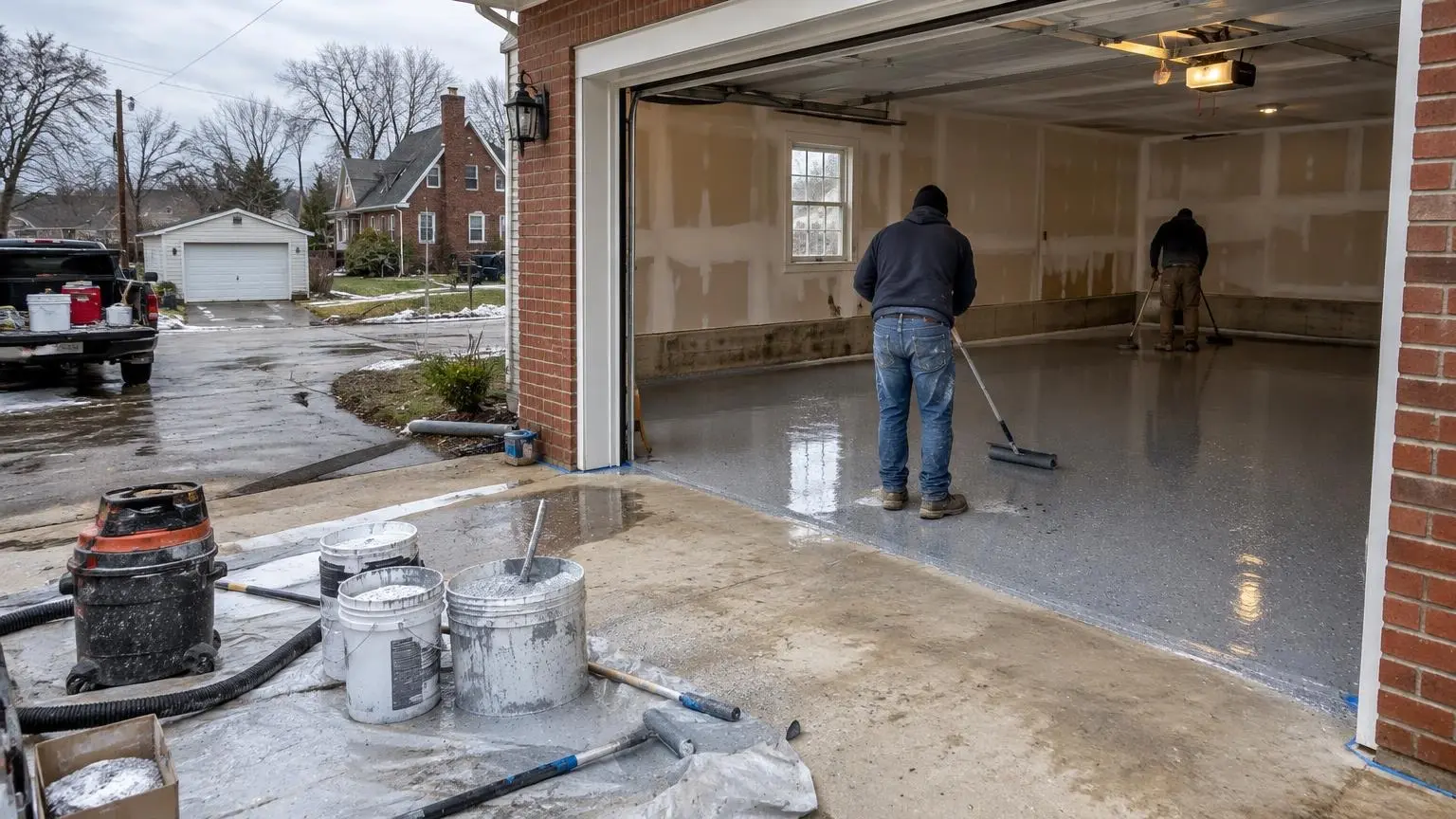
Epoxy flooring in Youngstown starts with the slab, and the slabs here have seen a lot. Wikipedia's climate figures for the city show about 67.8 inches of snow in an average year, a January mean of 26.8°F and roughly 41 inches of precipitation spread over about 168 days. That adds up to months of slush, brine and wet tires rolling into garages, then spring thaw pushing groundwater against basement walls. A floor coating in this valley has to bond to tired concrete and keep water and salt out of it.
A housing stock built before 1960
Youngstown grew with the steel mills, and its houses reflect that. American Community Survey data summarized by Point2Homes shows 39.3% of the city's homes were built in 1939 or earlier and another 23% in the 1950s, with a median build year of 1950. Nearly 79% are single-family detached houses. In practice that means a lot of poured basement floors and small detached garages that have been patched, painted or sealed more than once. Before we coat one of those floors, we find out what is already on it. Paint and old sealers have to come off. Hairline cracks get opened and filled. Low spots that hold water get noted so you know where puddles will sit.
Road salt and garage slabs
Wikipedia's article on road salt notes that it speeds up corrosion of reinforced concrete, and that magnesium chloride does far more damage to concrete surfaces than ordinary rock salt. Whatever mix ends up on the roads, your car drags it into the garage all winter. Bare concrete absorbs the brine, and the surface near the door starts to scale and pit. A sealed coating holds that brine on top, where a squeegee can push it out.
Basements in a humid valley
Wikipedia lists Youngstown's average relative humidity at 72.5% across the year. The EPA advises keeping indoor humidity under 60%, ideally 30 to 50%, and notes that warm, humid air condenses on cold surfaces. A basement slab in July is one of those cold surfaces. Moisture rising from the ground is the most common reason basement coatings blister, so every basement estimate includes a moisture test. Where the slab is damp, we use a moisture-tolerant primer or tell you the water source needs fixing first. Radon is worth a test too: the EPA calls it the number one cause of lung cancer among non-smokers, and a floor coating does not mitigate it.
Systems we install
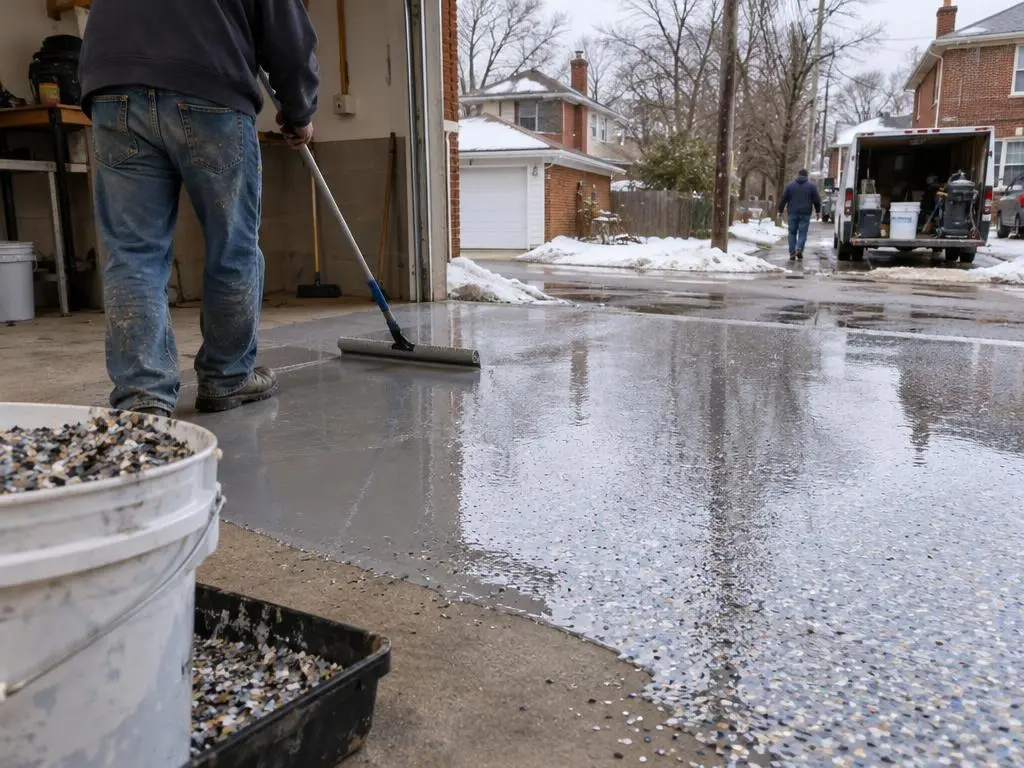
- Flake broadcast: colored vinyl chips seeded into a pigmented base and sealed under a clear topcoat. Hides salt film and grit and gives a little grip underfoot.
- Solid color epoxy: a thick, uniform coat for workshops, laundry rooms and utility spaces, with anti-slip grit added where floors get wet.
- Polyaspartic: a fast-curing coating you can usually walk on the same day, useful when the garage is the only way into the house.
- Metallic epoxy: a poured, marbled finish for finished basements and bars, where looks come first.
- Commercial and industrial: heavier 100% solids systems for shop floors, warehouses and food or retail spaces with rolling loads and spills.
What a typical garage job includes
- Moving through the plan with you: what leaves the garage and what we work around
- Moisture reading and a crack, spall and old-coating check
- Diamond grinding wall to wall, then a full vacuum
- Crack and joint repair with a fast-setting filler
- Base coat, flake or color layer, and a clear topcoat
- Walk, move-back and parking times in writing, plus winter cleaning tips
Our Epoxy Flooring Services
Six services covering the floors Mahoning Valley homes and businesses actually have: salt-worn garages, damp mid-century basements, cracked slabs and working shop floors.
Garage Floor Coating
A sealed, textured garage floor that keeps winter brine on the surface of the slab, prepped by diamond grinding.
Learn more →Epoxy Flake Floors
A resin floor packed with colored vinyl chips and sealed clear, made for garages and basements that see a long, salty winter.
Learn more →Polyaspartic Floor Coating
Fast-curing, UV-stable coating that gets you walking in hours and parking in about a day.
Learn more →Basement Floor Epoxy
Moisture-tested coatings for old basement slabs, from laundry areas to finished rooms with metallic finishes.
Learn more →Concrete Crack & Floor Repair
Crack filling, spall patching and resurfacing for aging slabs, alone or before a coating.
Learn more →Commercial & Industrial Floor Epoxy
Thick, chemical-resistant systems for shops, warehouses, plant floors and retail spaces.
Learn more →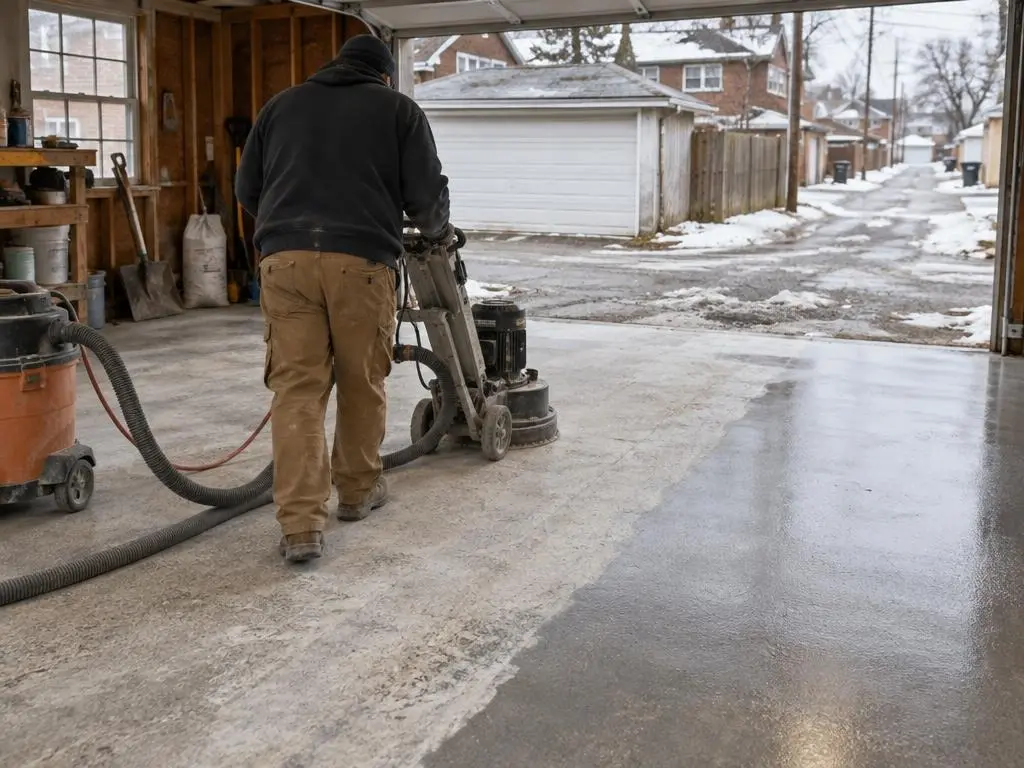
Where We Work
Youngstown is home base. From here we coat floors through Mahoning County (Boardman, Austintown, Canfield, Poland, Struthers, Campbell, Lowellville and New Middletown), into Trumbull County (Girard, Liberty Township, Hubbard, Niles, Mineral Ridge, Warren, Howland, Cortland, Lordstown and Newton Falls), south to Columbiana and Salem, and east across the state line to Hermitage and Sharon, Pennsylvania. The floors change as you move out. Youngstown, Campbell and Struthers have the oldest housing, much of it from the steel era, so we expect older slabs with paint, patches and salt wear. Boardman, Austintown and Howland grew mostly after World War II, so their slabs are usually younger. Across the state line, Hermitage and Sharon share the same winters and the same road salt. Every town page lists what we know about homes and floors there.
- Epoxy Flooring in Youngstown, OH
- Epoxy Flooring in Boardman, OH
- Epoxy Flooring in Austintown, OH
- Epoxy Flooring in Canfield, OH
- Epoxy Flooring in Poland, OH
- Epoxy Flooring in Struthers, OH
- Epoxy Flooring in Campbell, OH
- Epoxy Flooring in Lowellville, OH
- Epoxy Flooring in New Middletown, OH
- Epoxy Flooring in Girard, OH
- Epoxy Flooring in Liberty Township, OH
- Epoxy Flooring in Hubbard, OH
- Epoxy Flooring in Niles, OH
- Epoxy Flooring in Mineral Ridge, OH
- Epoxy Flooring in Warren, OH
- Epoxy Flooring in Howland Township, OH
- Epoxy Flooring in Cortland, OH
- Epoxy Flooring in Lordstown, OH
- Epoxy Flooring in Newton Falls, OH
- Epoxy Flooring in Columbiana, OH
- Epoxy Flooring in Salem, OH
- Epoxy Flooring in Hermitage, PA
- Epoxy Flooring in Sharon, PA
Why Homeowners Call Epoxy Flooring Youngstown
Old coatings come off
Paint, sealer and peeling kit epoxy are ground away. New coating goes on sound concrete only.
Every slab gets a moisture test
Basements and slab-on-grade garages are tested at the estimate, and the primer is chosen from the reading.
Built for brine
Garage systems get a chemical-resistant topcoat and texture so meltwater stays on the surface and the floor keeps some grip.
A quote you can read
Square footage, prep, each coat and the total are on paper. Scope changes are written up for your approval first.
Common Questions
How much does epoxy flooring cost in Youngstown?
HomeGuide's national figures put installed epoxy at $4 to $10 per square foot, which is about $1,600 to $5,800 for a two-car garage. Polyaspartic runs $5 to $12 per square foot in HomeGuide's guide. Grinding off old paint, filling cracks and moisture primers add to the total, so we price after seeing the slab.
Does Home Depot do epoxy flooring?
Home Depot sells garage floor kits, as do the Lowe's stores around the valley. Local listings run roughly $185 to $700 per kit, and HomeGuide puts premade kits at $200 to $700. Those are do-it-yourself products. The kit is rarely what fails; the prep is. Most kits rely on etching, while a professional floor starts with diamond grinding and crack repair.
What's the difference between epoxy and metallic epoxy?
Metallic epoxy is the same two-part resin with metallic pigments mixed in. It is poured and worked by hand so the pigment swirls into a marbled, three-dimensional look. This Old House puts metallic floors at about $5 to $12 per square foot. It suits basements and finished rooms better than garages, because it shows grit and scratches.
How long does epoxy flooring last?
HomeGuide estimates 10 to 20 years for solid (100% solids) epoxy and 3 to 5 years for water-based products. In Youngstown, how long a garage floor lasts depends heavily on prep and on how often salt brine is cleared off in winter.
Can you coat a basement floor that gets damp?
Sometimes. If the moisture test shows vapor coming through the slab, a moisture-tolerant primer can handle it. If water is actually entering through cracks or the wall joint, that needs fixing before any coating, and we will tell you so.
Can a garage floor be coated in the winter?
It can if the slab and air are warm enough for the product to cure. HomeGuide lists polyaspartic's application range as -30°F to 140°F, much wider than standard epoxy. For a cold detached garage we check slab temperature and may heat the space or schedule for spring.
Get an Epoxy Flooring Estimate
Free on-site estimates in Youngstown and across the Mahoning Valley.